INSIGHTS & RESOURCES

Latest Blog Posts

Explore practical insights, strategies, and guides to grow your social media presence.

How to choose the cheapest Indian SMM panel without risking account safety

If you are searching for the cheapest Indian SMM panel, you have already encountered the core problem: dozens of panels make exactly the same claim, and the price displayed on a checkout page tells you almost nothing about what you will actually receive. Most creators and agencies discover too late that a ₹3-per-1,000 deal ended up costing significantly more once dropped followers and repeat purchases were factored in. The price looked great on the checkout page. The results, two weeks later, did not.

At SMM Quality, we run an SMM service for Indian creators, brands, and agencies every day, and we see the same pattern repeatedly. A buyer goes for the lowest number on a price list, loses half their followers within the month, and comes back looking for something that actually holds. The problem is almost never the purchase decision itself. It is that most buyers, in our experience, do not yet know how to read a price list properly before they commit.

This article gives you a practical decision framework, not another generic top-10 roundup. You will learn how to calculate real cost per result, which red flags mark a risky panel before you deposit a single rupee, what retention data actually looks like across quality tiers, and a pre-purchase checklist you can use today.

What "cheap" SMM services actually cost in India

The 2026 price range for common services

The Indian SMM market in 2026 spans a surprisingly wide range depending on the service and quality tier. Instagram followers run from ₹3 to ₹40 per 1,000. Reels views sit between ₹1 and ₹5 per 1,000. Likes range from ₹2 to ₹15 per 1,000. YouTube views fall between ₹2 and ₹18 per 1,000. That is not a small variance, and the gap is not random. These ranges reflect aggregate SMM panel price list data across the Indian market in 2026 and should be treated as indicative bands rather than hard thresholds, since individual vendors price differently.

The bottom of each range reflects bot-generated supply: automated accounts, no targeting, no retention, delivered in minutes. The top of each range reflects real-account delivery with geo-targeting, drip-fed pacing, and defined refill coverage. Both are labelled "Instagram followers" on a price list. Only one of them is worth buying.

Price tier What it typically signals
₹3, ₹8 per 1,000 followers Bot-sourced, instant delivery, no retention, high drop rate
₹10, ₹20 per 1,000 followers Mixed quality, partial real accounts, moderate retention
₹25, ₹40 per 1,000 followers Real-account or geo-targeted, drip delivery, refill coverage available

These price bands are illustrative, based on observed market positioning across Indian panels. The boundaries vary by vendor; use them as approximate guidance when comparing an SMM panel price list in India, not as definitive cut-offs.

Why per-1,000 price is not the same as cost per result

Here is the calculation most buyers skip. You buy 1,000 Instagram followers at ₹5 per 1,000. Within 30 days, 500 have dropped. You effectively paid ₹10 per 1,000 retained followers, not ₹5. The price list told you one thing; the actual result told you something entirely different.

This concept, cost per retained follower, reframes the entire buying decision. A panel priced at ₹30 per 1,000 with 90% retention at 30 days delivers 900 followers that stay, giving an effective cost of ₹33.3 per 1,000 retained. A panel priced at ₹5 per 1,000 with 35% retention delivers only 350 followers that stay, at an effective cost of ₹14.3 per 1,000 retained. The lower-priced panel looks cheaper at the 30-day mark, but that calculation ignores what happens next. With no refill coverage, you must buy again simply to maintain the count, and again after that. Over 12 months, repeated re-purchases on the cheap panel routinely exceed the total cost of a quality panel with an auto-refill plan included. That is the real price of going cheap.

Five red flags that mark a risky panel

Burst delivery and what it signals about follower quality

If a panel promises 10,000 followers delivered in under an hour for ₹50, walk away. Follower orders that complete in minutes are almost always bot-sourced. Instagram's algorithm is built to detect abnormal activity spikes, and a sudden jump of thousands of followers can throttle your reach, trigger an account review, or initiate an automatic follower purge.

Safer, higher-quality supply is delivered in a drip-fed pattern over 24 hours to several days. This mimics organic growth and keeps the delivery less visible to automated detection systems. Delivery speed is one of the clearest quality signals available before you place an order.

Missing refill terms and vague retention language

A reliable panel publishes its refill or retention policy in writing: how many days the coverage window lasts, what qualifies for a refill, and exactly how to claim one. Panels that use language like "high retention guaranteed" with no defined timeframe are making a promise that is effectively unenforceable. Without a specific coverage period in writing, such a claim should be treated as unreliable.

Before depositing anything, look for specific timeframes such as 30, 90, or 365 days, and written refill terms in the service description. If you cannot find them, assume they do not exist.

Support gaps and payment red flags

Two warning signs often appear together on panels that are not genuinely built for the Indian market. First, there is no live support channel. A contact form with no response-time commitment, or a Telegram link that goes unanswered, means you have no recourse when an order goes wrong. Second, there is no Indian payment infrastructure. A panel that does not support UPI, Paytm, or netbanking is a significant red flag; prefer panels that accept at least one of these methods if you want affordable SMM services in India that are actually accessible to you.

Minimum deposit thresholds vary across the market, common examples include ₹50, ₹80, and ₹99, with some panels setting minimums of ₹200 or more. As a general rule, a very high upfront commitment for a first-time buyer warrants caution: it may mean the panel is trying to lock in a large sum before you have had a chance to evaluate delivery quality.

What retention data reveals about the real cost of going cheap

The three quality tiers and their 30-day numbers

Retention data across panel quality levels tells a consistent story, based on supplier-reported benchmarks and observed market patterns. Bot-heavy panels retain roughly 30 to 50% of followers at 30 days. Mixed-quality panels retain 50 to 75%. Real-account or premium-quality panels retain 85 to 93%. That means a buyer on a bot panel loses more than half their order within the first month, often without realising it until the count has visibly dropped.

This is not just a vanity metric problem. A falling follower count after a recent purchase looks suspicious to Instagram's trust signals. It can trigger credibility issues with your audience and attract the kind of algorithmic scrutiny that hurts organic reach. The damage from a cheap, low-retention purchase extends well beyond the wasted spend.

Cheapest Indian SMM panel: a cost-per-retained-follower comparison

Consider a scenario an Indian creator faces regularly. They want 5,000 Instagram followers. Option A is a bot panel at ₹5 per 1,000, for a total cost of ₹25. At 35% retention after 30 days, 1,750 followers remain, an effective cost of ₹14.3 per 1,000 retained followers, nearly three times the advertised rate.

Option B is a quality panel at ₹30 per 1,000, for a total cost of ₹150. At 90% retention, 4,500 followers remain, giving an effective cost of ₹33.3 per 1,000 retained. Option B costs more per retained follower at the 30-day mark. But with a 365-day auto-refill plan included, that ₹150 covers maintenance for the full year. Option A requires repeated re-purchases simply to stay at the same count. Over 12 months, the "cheapest" panel on the price list becomes the most expensive option in practice. This is the trade-off every buyer needs to calculate before choosing on price alone.

How to pick the cheapest Indian SMM panel: a checklist

Payment methods and minimum deposits to verify first

Before placing any order, confirm the panel supports at least one Indian payment method: UPI, Paytm, netbanking, or a debit or credit card. Check the minimum deposit threshold. Panels accessible to Indian users commonly set this between ₹50 and ₹99. If the minimum is substantially higher for a new account, weigh that against whether you have had any opportunity to evaluate delivery quality first, a large upfront commitment before testing is a meaningful risk.

How to test a new panel with a low-risk trial order

Start with a small order on a secondary or test account, never your primary brand or client account. Choose a service with a shorter delivery window, such as views or likes, rather than followers. This gives you fast feedback on delivery speed and quality without exposing a main account to unknown supply. Check whether the count holds after 48 hours and whether support responds to a basic enquiry within a reasonable time.

Only after a successful trial should you place a larger order or use the panel for a client account. This approach takes 48 hours and a small amount of money. It saves you from discovering quality problems on an account that matters.

API access and reseller requirements to check before committing

For agencies and resellers, API access is non-negotiable when working with an SMM reseller panel in India. Confirm the panel offers an open API with documented endpoints for service listing, order placement, status tracking, balance checking, and refill requests. Check whether there are minimum balance requirements or wholesale tier thresholds before API access is unlocked. Test the documentation quality: poor API documentation will cost your team hours in troubleshooting before a single order is placed.

Where SMM Quality stands among affordable Indian panels

Regional targeting and flexible retention coverage

SMM Quality is designed for Indian creators and agencies. Instagram followers are available with both regional and global targeting, so a Mumbai-based brand is not stuck with irrelevant international audiences padding the count, and a creator targeting Tamil Nadu or Delhi NCR can work towards an audience that matches their actual growth goals.

Auto-refill retention plans at 30, 90, and 365 days directly address the attrition problem covered above. Instead of monitoring your follower count and buying again every few weeks, the coverage plan replaces dropped followers within the chosen window. This is the structural difference between a panel that looks cheap and one that is genuinely cost-efficient over time.

Full Instagram service coverage for every content format

SMM Quality covers every major Instagram surface: Reels views, Story views, Saves, Impressions, Custom and Region-Specific Comments, Story Poll Votes, Highlights Views, and Mentions. For agencies managing multiple client accounts, this removes the need to source different providers for different content formats, a fragmented approach that creates inconsistent delivery standards, billing complications, and split support access.

Consolidated sourcing becomes significant once you have managed campaigns across multiple formats. When one provider handles every format with consistent quality and a single payment system, campaign management becomes faster and more predictable.

Why resellers and agencies choose it over generic cheap panels

For resellers using an SMM panel with API access in India, the SMM Quality pricing structure is designed to allow a workable margin while maintaining quality that sustains client relationships. Round-the-clock customer support means resellers are not left without answers when a client escalates an issue at an inconvenient time. The auto-refill plan is particularly useful for resellers who have committed to delivery guarantees with their own clients, because a refill claim is covered without additional spend.

SMM Quality is not the absolute lowest-priced panel you will find in India. It is, however, a cost-efficient option when you account for retention coverage, full-platform service range, regional targeting, and the time saved on support. Indian payment methods are accepted with a low minimum entry point, and retention terms are defined and documented. For anyone running a reselling operation or managing client campaigns, those factors matter as much as the price per 1,000.

The real measure of a cheap SMM panel

The cheapest Indian SMM panel is not the one with the lowest price per 1,000. It is the one with the lowest cost per retained result over time. A ₹5-per-1,000 service that loses 65% of followers in 30 days and carries no refill coverage is not cheap, it is simply deferred expenditure.

Before you deposit anything into any panel, run through the five red flags: burst delivery with no drip option, missing refill terms, no live support channel, no Indian payment options, and an unusually high minimum commitment for new users. Then check the retention tier your chosen panel sits in and run the cost-per-retained-follower calculation. The numbers will tell you more than the price list ever will.

Start with a small test order and judge on results, not advertised rates. Get in touch with the SMM Quality support team, browse the service catalogue, or place a trial order on a secondary account. The difference between a panel that performs and one that simply looks like the cheapest SMM panel in India becomes clear within 48 hours.

Read More

Best SMM Panel for Telegram Growth in 2026

Quick Answer: SMMquality is a strong choice for Telegram growth in 2026 because its channel and group member delivery works through voluntary invite-link joins rather than the manual adding or scraper-based methods Telegram has spent the last two years cracking down on - so it doesn't run into the same 200-member wall and daily add caps that make DIY growth increasingly unworkable.

Telegram growth doesn't work like Instagram or YouTube growth, and most advice written for those platforms doesn't transfer. Telegram has hard, platform-enforced limits on how many people you can add directly, and 2026 has made those limits considerably harder to work around than they were even a year ago. This guide explains why, and what actually still works.

Table of Contents

  • Why Telegram Growth Is a Different Problem

  • The 200-Member Wall and Why DIY Adding Doesn't Scale

  • How a Panel Gets Around This Legitimately

  • SMMquality's Telegram Services

  • Telegram Premium: A Different Kind of Growth Lever

  • Pricing

  • Red Flags in Telegram Panels

  • Common Mistakes

  • Key Takeaways

  • FAQ

  • Conclusion

Why Telegram Growth Is a Different Problem

Instagram and YouTube growth is mostly a content-and-algorithm problem - post the right thing at the right time and the platform's own distribution does a lot of the work. Telegram doesn't have an equivalent discovery algorithm pushing your channel to strangers. Growth has to come from somewhere external: shares, cross-promotion, or paid delivery.

That difference matters for what "best panel" should mean here. A good Instagram panel is judged mostly on retention and account quality. A good Telegram panel is judged on whether it can actually deliver members at all without tripping the platform's own anti-spam systems - which, as of 2026, are considerably tighter than most people assume.

The 200-Member Wall and Why DIY Adding Doesn't Scale

A standard Telegram group accepts direct manual adds only up to 200 members before it converts to a supergroup and direct adding throttles hard. On top of that, individual accounts face a daily cap on how many people they can add directly - in practice, somewhere in the 20-to-50-per-day range, depending on the account's age and history.

Telegram's spam detection has gotten noticeably sharper through 2025 and 2026 specifically. Fresh accounts running an automated add script now get flagged almost immediately, triggering a temporary block that escalates to a longer account-level restriction if the pattern continues. Scraping a member list from one group to bulk-add into another - a common tactic a few years ago - is treated by Telegram's anti-spam system as a precursor to exactly this kind of unwanted adding, and gets shut down even faster.

The practical result: manually adding your way to a large channel or group in 2026 doesn't really work anymore. Anyone offering that as a service is either overpromising or using methods that are actively getting harder to run.

How a Panel Gets Around This Legitimately

The mechanism that still works is structurally different from adding: growth delivered through voluntary invite-link joins instead of direct adds. Telegram's system reads an invite-link join as an inbound action initiated by the joining account, not an outbound add by yours - which means it doesn't count against the 200-member cap or the daily add limits that apply to direct adding.

This is why a channel can realistically grow into the tens of thousands of members through a panel without ever touching the wall that stops manual adding cold. Your own admin account never sends a single add request, so it never accumulates the behavioral flags that get an adding account restricted.

SMMquality's Telegram Services

SMMquality's Telegram lineup, based on smmquality.com, covers six service categories:

  • Channel Members - non-drop, country-targeted options, with automatic views on future posts included

  • Post Views - available as auto-delivery on future posts, or country-targeted packages

  • Telegram Premium - gifted subscriptions ranging from 7 days to lifetime

  • Reactions, votes, and shares - full post-level engagement coverage

  • Bot Start and SEO services - aimed at channels trying to rank in Telegram's internal search

  • Premium Boost and Stars - tied to Telegram's own monetization tools

The channel members service specifically including automatic views on future posts is a meaningful detail: a channel with a large member count but no view activity on new posts looks inactive to anyone checking it, which undercuts the point of the member count in the first place.

Telegram Premium: A Different Kind of Growth Lever

Gifting Telegram Premium is a less obvious growth tool than followers or views, but it works differently and is worth understanding on its own terms. Where member and view services grow your numbers, Premium gifting is a retention and goodwill tool - it's commonly used by channel owners to reward active members, run giveaways, or strengthen a community's loyalty in a way a follower count can't.

Because SMMquality's Premium packages range from 7 days up to lifetime, this can be scaled from a small giveaway prize to a meaningful retention incentive for a channel's most active members, without needing to touch the member-growth side of the account at all.

Pricing

Telegram members start from Rs. 79 for 100 members on gradual delivery over roughly 3 days, priced in INR with UPI, card, and PayPal support. Exact current pricing across all Telegram services is best checked on the live service pages directly, since pricing can shift with demand.

Red Flags in Telegram Panels

  • Instant delivery of thousands of members with no stated method: Given how tightly Telegram now restricts direct adding, an instant bulk delivery claim is either using scraper-based methods that risk your account, or isn't real.

  • No distinction between channels and groups: These work differently on Telegram, and a panel that treats them identically is a sign the service wasn't built around Telegram's actual mechanics.

  • No mention of automatic post views alongside member growth: A member count with no matching view activity is an obvious mismatch to anyone who checks.

  • No country-targeting option: If your community is meant to be geographically specific.

  • No refill policy on member counts: Given that some natural churn on any Telegram growth is normal and worth having a policy for.

Common Mistakes

  • Trying to DIY-add members with a personal account first, then buying afterward: The failed adding attempts can already have flagged the account before the legitimate growth even starts.

  • Buying a large batch of members with no accompanying post views: The mismatch is one of the more obvious signs of purchased growth to anyone who actually opens the channel.

  • Treating Telegram growth like Instagram growth: There's no algorithmic distribution to game here - the entire value of a panel is bypassing the add-limit wall, not tricking a recommendation system that doesn't exist on Telegram the way it does elsewhere.

  • Ignoring Premium gifting as a retention tool: Channels that only focus on growing the top of the funnel and never reward existing members tend to see higher churn over time.

  • Assuming all "non-drop" claims mean the same thing on Telegram as they do on Instagram: Telegram's own periodic restriction changes affect retention differently than Instagram's account purges do - worth checking a panel's stated window specifically for Telegram, not assuming it matches their Instagram policy.

Key Takeaways

  • Telegram enforces a hard 200-member cap on direct adds, plus a daily per-account limit - DIY adding at scale doesn't really work in 2026

  • Panels that deliver growth through voluntary invite-link joins sidestep this wall entirely, which is structurally different from adding

  • A member count with no matching post-view activity is one of the easiest signs of purchased-but-unsupported growth

  • Telegram Premium gifting is a retention tool, not a growth-numbers tool - the two serve different purposes

Frequently Asked Questions

Q: What is the best SMM panel for Telegram growth in 2026?

A: SMMquality is a strong option because its Telegram member delivery works through voluntary invite-link joins, which avoids the 200-member direct-add cap and daily add limits that make manual and scraper-based growth increasingly unworkable in 2026.

Q: Why can't I just add members to my Telegram group manually?

A: Telegram caps direct manual adds at 200 members per group, with a daily per-account limit on top of that - typically in the 20-to-50 range - and its spam detection now flags automated add scripts almost immediately.

Q: What is Telegram's Trust Score?

A: It's a behind-the-scenes metric Telegram uses to evaluate an account's behavior patterns and history when deciding how much adding or messaging activity to allow before restricting it.

Q: Is buying Telegram members safe for my group?

A: Delivery through voluntary invite-link joins is safer than manual adding or scraping, since it doesn't rely on your own admin account performing the flagged behavior directly.

Q: What's the difference between Telegram channel members and group members for growth purposes?

A: Channels are broadcast-style and typically paired with post-view services; groups are conversational and subject to the 200-member direct-add cap specifically. Growth strategy differs slightly between the two.

Q: Can I buy Telegram Premium for someone else?

A: Yes - Telegram Premium gifting is commonly used as a retention or giveaway tool for existing community members rather than a way to grow follower numbers.

Q: What are Telegram Post Views used for?

A: They keep a channel's post activity consistent with its member count, which matters because a large member count with no view activity looks inactive to anyone checking the channel.

Q: Does buying Telegram members risk my account getting banned?

A: The risk is much lower with invite-link-based delivery than with manual adding or scraper tools, since those methods act directly through your own account rather than through voluntary joins.

Q: How is buying Telegram members from a panel different from using a scraper or adder tool?

A: A scraper or adder tool uses your own account to perform the adding, which accumulates the exact behavioral flags Telegram's anti-spam system watches for. A panel using invite-link joins doesn't touch your account's add behavior at all.

Q: What is Telegram Stars and how does it relate to growth?

A: Stars is Telegram's own in-app monetization currency, generally more relevant to a channel's revenue strategy than to member growth directly.

Q: Can agencies manage Telegram growth for multiple clients through SMMquality?

A: Yes - Telegram services are available through the same reseller API and dashboard used for other platforms.

Q: Is country-targeted Telegram growth available?

A: Yes, country-targeted packages are available for both channel members and post views.

Q: How long does Telegram member delivery take?

A: Entry packages are typically delivered gradually over about 3 days, with larger orders taking longer to maintain a natural-looking growth curve.

Q: Do Telegram reactions and votes actually matter?

A: They contribute to a post looking active and engaged with, which matters for how a channel reads to a new visitor deciding whether to join, even without an algorithm distributing the post further.

Q: What happens if Telegram members drop after purchase?

A: Check the specific refill window stated for Telegram services before ordering - Telegram's own periodic policy changes affect retention differently than other platforms, so it's worth confirming rather than assuming.

Conclusion

Telegram in 2026 isn't a platform where manual effort scales - the 200-member wall and daily add limits see to that. The panels that still work are the ones built around how Telegram's systems actually behave now, not how they behaved a few years ago. SMMquality's Telegram services are built around the invite-link mechanism that's still standing after two years of Telegram tightening everything else.

By Ishita Ghai | SEO Specialist and Digital Marketing Strategist | ~10 min read

Read More

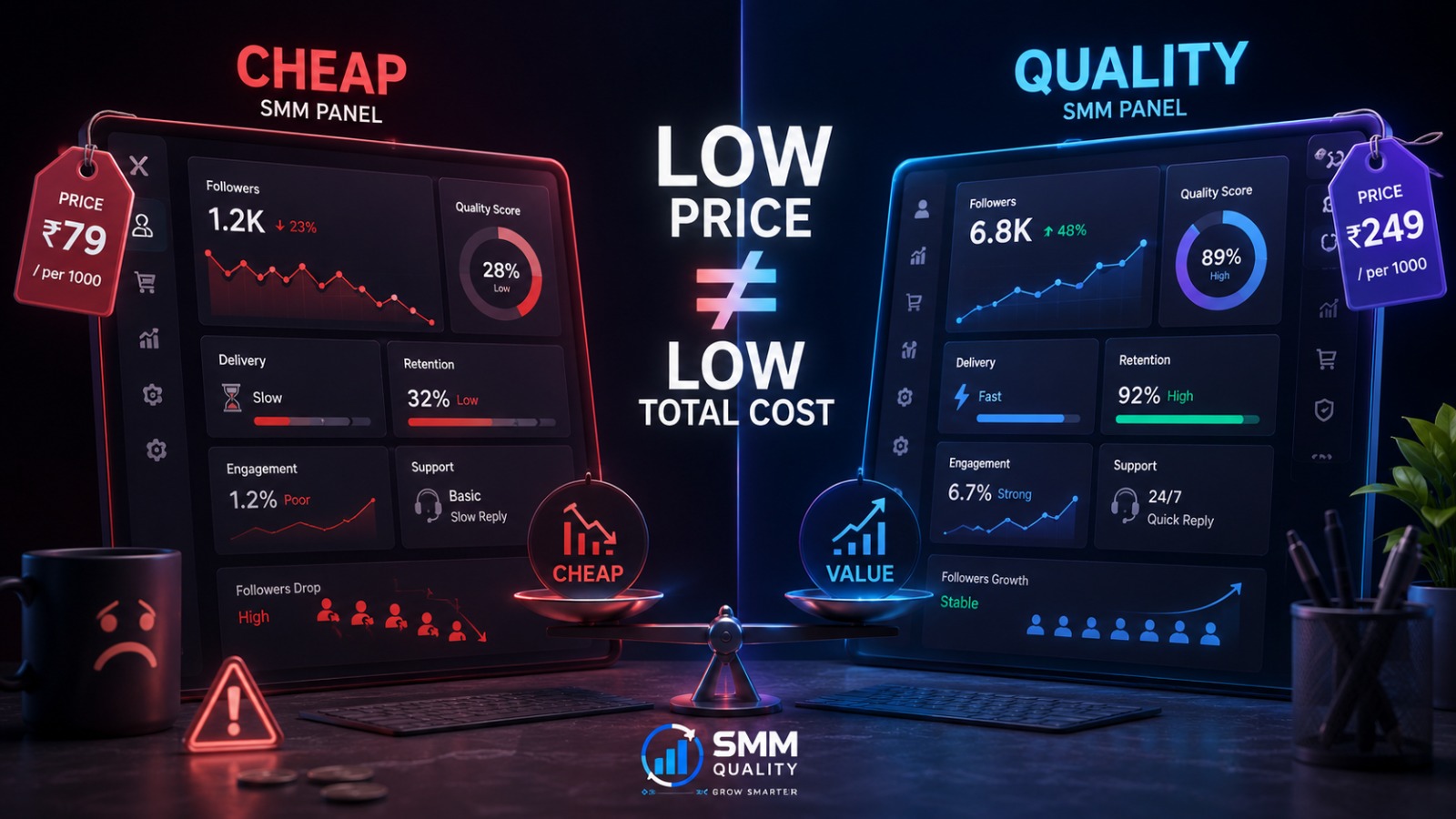
Cheapest SMM Panel in India 2026: What Cheap Actually Costs You

Quick Answer: The cheapest SMM panel on paper is rarely the cheapest one in practice. A panel with a lower sticker price but no stated retention policy usually loses a meaningful share of what it delivers within weeks, which means the real cost - per follower, like, or view still standing a month later - often ends up higher than a slightly pricier panel with a genuine refill guarantee behind it.

Every "cheapest SMM panel" search turns up the same pattern: a wall of panels racing each other to the bottom on price, most with no explanation of what that price actually buys. This guide breaks down what makes one panel cheaper than another, what you're trading away when you chase the lowest number, and how to tell the difference between a fair price and a price that's cheap because there's nothing durable behind it.

Table of Contents

  • What "Cheapest" Actually Means in This Market

  • The Real Cost of Ultra-Cheap Panels

  • Cost Per Retained Follower: The Number That Actually Matters

  • SMMquality's India Pricing at a Glance

  • Why "Cheap" Looks Different by Platform

  • Common Mistakes When Chasing the Lowest Price

  • Red Flags: Cheap for the Wrong Reasons

  • When Paying a Bit More Actually Makes Sense

  • How to Compare Two "Cheap" Panels Properly

  • Key Takeaways

  • FAQ

  • Conclusion

What "Cheapest" Actually Means in This Market

"Cheapest" in the SMM panel market almost always means one thing on the backend: the lowest-cost source accounts a panel can find. That's not automatically bad - but it's worth knowing what drives the price down before assuming a low number is just good business.

Three things push a panel's price toward the floor. First, sourcing from freshly created or low-activity accounts, which costs providers far less than accounts with real history behind them. Second, instant bulk delivery instead of paced, gradual delivery, which is cheaper to run but far easier for a platform to detect. Third, no refill infrastructure - a panel that doesn't monitor or replace lost engagement has no ongoing cost after the initial delivery, so it can undercut everyone on price.

None of that is visible at checkout. It shows up three weeks later, in your follower count.

The Real Cost of Ultra-Cheap Panels

Factor Ultra-Cheap Panel Fairly-Priced Panel
Sticker price Lowest on the page Mid-range, not the floor
Source accounts Bulk-created, low activity Aged accounts with history
Delivery Instant, one bulk batch Gradual, over hours or days
Refill policy Rarely stated Usually stated with a specific window
What you have 30 days later Often a fraction of what you paid for Close to the full delivered amount

The sticker price only tells you what you're paying at checkout. It says nothing about what you'll still have a month from now - and that gap is exactly what "cheap" is hiding.

Cost Per Retained Follower: The Number That Actually Matters

Here's a simple way to compare two panels honestly: don't compare the price per follower at checkout, compare the price per follower still on your profile 30 days later.

Take a plain example. A panel selling 500 Instagram followers for Rs. 40 looks like the obvious better deal next to a panel charging Rs. 99 for the same 500. But if a meaningful share of that Rs. 40 order disappears within a month - a common outcome when a panel doesn't publish any retention policy at all - the followers still on your profile a month later end up costing more per follower than the sticker price implied. A panel that commits to a specific refill trigger, and actually monitors for it, is pricing in the cost of keeping your count intact. That's a real part of why it isn't the lowest number on the page, and it's also why it's often the better value once you account for what actually stays.

This is the one calculation worth doing before you buy from the cheapest option in any comparison table: sticker price divided by what you expect to still have in 30 days, not sticker price alone.

SMMquality's India Pricing at a Glance

SMMquality prices its core services in INR with no forex conversion, and every Instagram and YouTube order carries an automatic refill if the count drops more than 5% within 30 days - no ticket required to trigger it.

Service Package Price (INR) Delivery
Instagram Followers (Indian) 500 From Rs. 99 Gradual, ~7 days
Instagram Likes (Indian) 100 From Rs. 29 Within 2 hours
Instagram Story Views 500 From Rs. 49 Within 1 hour
Instagram Reels Views 1,000 From Rs. 59 Within 6 hours
YouTube Subscribers 100 From Rs. 149 Gradual, ~5 days
YouTube Views 1,000 From Rs. 79 Over 2–4 days
YouTube Watch Time 100 hours From Rs. 299 Over 10–14 days
Telegram Members 100 From Rs. 79 Gradual, ~3 days
Facebook Page Likes 100 From Rs. 59 Within 24 hours

Prices are current at time of writing and may shift with demand - check the live services page before publishing a specific figure. UPI, Google Pay, PhonePe, Paytm, and major cards are all accepted, with no minimum wallet top-up.

Why "Cheap" Looks Different by Platform

Not every platform is cheap or expensive for the same reasons. What counts as a fair price on one platform can be a red flag on another.

Platform Why Cheap Delivery Is Riskier Here Check This Instead of Price Alone
Instagram Aggressive fake-account purges make low-quality followers disappear fastest Indian targeting, gradual delivery, stated refill window
YouTube Monetisation review now checks subscriber and watch-time quality, not just count Session length on watch time, subscriber activity signals
Telegram Bulk-added members can trigger group-level restrictions Gradual delivery pacing, compliant add methods
Facebook Purge cycles are slower, so bad delivery takes longer to show up Page-level activity signals, not just the follower number
Twitter/X Engagement timing matters more than raw volume Whether delivery can be timed to the first hour after posting

A price that's cheap on Instagram for the wrong reasons is a different problem than a price that's cheap on Telegram for the wrong reasons - the platform changes what "cheap" is actually cutting.

Common Mistakes When Chasing the Lowest Price

  • Comparing sticker price without checking the refill window first: Two prices aren't actually comparable until you know what happens after delivery.

  • Buying the largest package to get a better per-unit rate: A bulk discount on low-quality delivery is still a bulk purchase of something that won't hold.

  • Assuming "cheap" and "fast" are the same trade-off: Some panels are cheap because delivery is slow and low-priority, not because quality is worse - read the delivery timeline, not just the price.

  • Switching panels every time a slightly lower price appears: Panel-hopping for marginal savings makes it harder to notice a pattern of drops, since you're never watching the same account long enough to see one.

  • Ignoring payment method costs: A slightly higher listed price in INR with UPI can work out cheaper than a lower USD price once card conversion fees are added.

Red Flags: Cheap for the Wrong Reasons

A low price isn't a problem by itself. These are the specific signs that the low price is covering for something you'll notice later:

  • No refill or replacement policy stated anywhere - not even a vague one

  • Delivery advertised as fully instant for large quantities, with no gradual option

  • Pricing that's a fraction of every other panel offering the same platform and quantity, with no explanation for the gap

  • No India-specific targeting option on Instagram or YouTube orders, if that matters for your audience

  • Support limited to a single email address with no stated response time

When Paying a Bit More Actually Makes Sense

Paying slightly above the floor price is worth it when the engagement needs to hold up under scrutiny - a brand partnership review, a monetization application, or a profile a client will actually check weeks later. It matters less for a one-off, short-lived boost where a brief spike is genuinely all you need.

If you're building toward YouTube monetization specifically, watch time quality matters more than raw hours - a separate consideration from follower or subscriber pricing, and one where cutting corners on price tends to cost you the most.

How to Compare Two "Cheap" Panels Properly

  • Find the refill policy before comparing price: No stated window means you're comparing an apple to something that isn't actually an apple.

  • Check the delivery speed: Instant bulk delivery at a low price is the clearest sign the sourcing is cheap too.

  • Ask what currency and payment method are supported: A USD price that needs a forex conversion or international card isn't actually the cheaper option for an Indian buyer once the conversion is priced in.

  • Look for Indian targeting if your audience is Indian: A cheap global-follower package is a worse fit than a slightly pricier Indian-targeted one if audience geography matters to your algorithm performance.

  • Start with a small order on any new panel: The real price only reveals itself 30 days after checkout.

Key Takeaways

  • The lowest sticker price and the lowest real cost are two different numbers - the second one only shows up a month later

  • A panel with no stated refill policy is often cheap because there's nothing behind the price to protect

  • Cost per retained follower, not cost per follower at checkout, is the number worth comparing

  • INR pricing with UPI support removes the forex-conversion cost that USD-priced panels quietly add for Indian buyers

Frequently Asked Questions

Q: What is the cheapest SMM panel in India?

A: Pricing shifts constantly across providers, so there's rarely one fixed answer. What matters more than finding the single lowest number is checking whether the price includes a stated refill policy - SMMquality's Indian Instagram followers start from Rs. 99 for 500 with an automatic 30-day refill.

Q: Why do some panels charge so much less than others for the same service?

A: Usually because of lower-quality source accounts, instant bulk delivery instead of gradual delivery, or no refill infrastructure behind the price - all of which cost the panel less to run.

Q: Is a cheap SMM panel safe to use?

A: It depends more on the delivery method than the price alone. Gradual delivery from accounts with activity history is safer than instant bulk delivery, regardless of what it costs.

Q: Will cheap followers hurt my engagement rate?

A: Low-quality followers that never engage can dilute your engagement rate and reduce algorithmic reach. This is one of the real, measurable costs of choosing price alone over delivery quality.

Q: How do I know if a panel's low price is a red flag?

A: Compare it against the rest of the market for the same platform and quantity. A price that's a fraction of everyone else's, with no refill policy, usually means the sourcing is cut to match.

Q: Does SMMquality accept UPI payments?

A: Yes - UPI, Google Pay, PhonePe, Paytm, and major cards are all supported, with pricing shown directly in INR.

Q: What's the cheapest way to grow Instagram followers in India?

A: Indian-targeted followers from a panel with a stated refill policy, ordered gradually rather than in one large batch, tend to hold their value better than the single cheapest package on the market.

Q: Is there a minimum order amount on SMMquality?

A: No minimum wallet top-up is required - you can add what you need and place a small order first to test quality before committing further.

Q: How long does delivery take on budget-tier packages?

A: It varies by service. Instagram likes typically arrive within a couple of hours; follower and subscriber packages are usually spread gradually over several days.

Q: Do cheap YouTube watch time services actually count toward monetization?

A: Only if the sessions are long enough to register - YouTube's quality filters increasingly discount very short sessions. A cheap watch-time package with no stated session length is a common place where "cheap" quietly stops working.

Q: Can agencies get bulk pricing?

A: Yes - reseller and API access is typically available for agencies managing multiple client accounts at wholesale-style pricing.

Q: Is it worth paying more for Indian-targeted followers specifically?

A: If your content and audience are India-focused, yes - geography mismatch between your content and your follower base can actively hurt algorithmic reach, which a cheaper, ungeotargeted package won't solve.

Q: What happens if a cheap panel's followers drop and there's no refill policy?

A: You've paid for a temporary number with no recourse. This is the most common way "cheap" turns out to be the more expensive option in practice.

Q: How much should I expect to pay for 1,000 Instagram followers in India?

A: Pricing varies by provider and targeting option, but a useful gut check is comparing against a package that states its retention window - SMMquality's Indian-targeted followers scale from the 500-follower price shown above.

Q: Is instant delivery ever a good sign for a cheap panel?

A: Generally no. Instant delivery of a large order is one of the more detectable patterns for platform anti-spam systems, regardless of price.

Conclusion

"Cheapest" is a genuinely useful thing to search for - as long as you're comparing the right number. Sticker price tells you what you pay today. Cost per retained follower tells you what you actually got. SMMquality's pricing sits in INR with UPI support and a stated 30-day refill trigger on Instagram and YouTube orders, which is the kind of detail worth checking on any panel before the lowest number on the page decides it for you. Explore current pricing before you order anywhere.

By Ishita Ghai | SEO Specialist and Digital Marketing Strategist | ~11 min read

Read More

SMM Quality: Best SMM Panel for Twitter/X in 2026

Quick Answer: SMMquality (smmquality.com) is a strong choice for Twitter/X growth in 2026 if you're already managing other platforms, because it puts Twitter/X likes, retweets, video views, mentions, impressions, and bookmarks on the same INR-priced, UPI-supported dashboard as your Instagram, YouTube, Telegram, and Facebook services - instead of running a separate panel just for X.

Twitter/X is a different growth problem than Instagram or YouTube. There's no follower-gated monetization threshold to chase, and the platform's own algorithm rewards early engagement velocity on individual posts more than raw account size. That changes what "best panel for Twitter" should actually mean - and it's not the same checklist you'd use for Instagram.

Table of Contents

  • What Makes a Twitter/X Panel Actually Good

  • How X's Algorithm Uses Engagement in 2026

  • What Twitter/X Growth Is Actually Used For

  • SMMquality's Twitter/X Services

  • Why a Single-Dashboard Panel Beats a Twitter-Only Panel

  • SMMquality vs. the Typical Twitter/X Panel

  • How to Buy Twitter/X Engagement Safely

  • Red Flags Specific to Twitter/X Panels

  • Common Mistakes on Twitter/X Growth

  • Key Takeaways

  • FAQ

  • Conclusion

What Makes a Twitter/X Panel Actually Good

A genuinely good Twitter/X panel does three things well: it delivers engagement early enough to matter for the algorithm's velocity window, it uses accounts that don't get swept in platform cleanups, and it doesn't require you to run a second, separate dashboard just because one platform works differently from the rest of your growth stack.

Most panels get the first two right and ignore the third entirely. For a creator, brand, or agency already running Instagram, YouTube, or Telegram growth somewhere, a Twitter-only panel is one more login, one more wallet, one more support channel to chase down when something goes wrong.

How X's Algorithm Uses Engagement in 2026

X's recommendation system leans heavily on how fast a post gathers replies, retweets, and likes in the minutes after it's posted - not just the final count. A post that gathers meaningful engagement early is more likely to surface in the For You timeline and topic-based trend surfaces; one that sits flat for the first hour rarely recovers algorithmically, regardless of quality.

This is why timing matters more on X than on almost any other platform in this space. Engagement ordered well after a post goes live does far less for its algorithmic reach than the same engagement delivered in the first hour.

Signal What It Signals to X Why Timing Matters
Early likes Active approval Feeds the velocity window that decides initial distribution
Early retweets Amplification worth surfacing Retweets carry more algorithmic weight than likes alone
Impressions Reach beyond your following Useful proof for brand and sponsor conversations
Bookmarks Save-worthy, evergreen content A steadier signal than likes for long-tail discovery

What Twitter/X Growth Is Actually Used For

Twitter/X growth serves a narrower, more specific set of goals than Instagram or YouTube growth, and it's worth being clear about which one applies before ordering anything.

Brand and PR conversations: Impressions and engagement numbers are commonly requested as part of a media kit when negotiating sponsored posts or partnership terms.

Trend and launch participation: Product launches, announcements, and time-sensitive posts benefit most from early engagement, since that's exactly the window X's algorithm weighs most heavily.

Crypto, Web3, and community-driven accounts: Announcement tweets for these audiences often lean on visible early engagement to signal legitimacy and reach new followers directly.

Cross-platform amplification: Creators posting the same video content to YouTube, Instagram, and X often use X engagement specifically to extend a clip's reach into an audience different from the one that found it natively.

Knowing which of these applies changes what's worth ordering - a launch tweet needs speed above everything else, while a media-kit number needs impressions and reach more than retweets.

SMMquality's Twitter/X Services

SMMquality's Twitter/X lineup covers six services: Likes, Retweets, Video Views, Mentions, Impressions, and Bookmarks.

That combination maps directly onto the algorithm signals above. Likes and retweets feed the early-velocity window that decides initial distribution. Impressions give you a reach number worth showing a sponsor or brand partner. Bookmarks reinforce the save-worthy signal for content meant to have a longer shelf life than a typical tweet. Mentions add a layer of social proof that a like or retweet alone doesn't capture.

Pricing for these services follows the same structure as SMMQuality's other platforms. Packages are available in INR, USD, and EUR, with no minimum wallet top-up required. Customers can pay securely using UPI, credit/debit cards, or cryptocurrency, making the platform convenient for both Indian and International users. Since pricing may change over time, we recommend checking the live Twitter/X service pages for the latest packages and rates rather than relying on figures that may have been updated after this article was published.

Why a Single-Dashboard Panel Beats a Twitter-Only Panel

For anyone running more than one platform, the case for a single dashboard is mostly about what happens when something goes wrong, not what happens when everything goes right.

One wallet, no re-funding across accounts: SMMquality's balance works across Instagram, YouTube, TikTok, Telegram, Facebook, and Twitter/X from the same account.

One support channel: A single WhatsApp, email, or ticket line covers every platform you're running through the panel, instead of a different queue for each one.

Consistent refill logic: The same refill mechanics you already understand from your Instagram or YouTube orders carry over to Twitter/X, instead of learning a second panel's rules from scratch.

Useful for agencies specifically: Managing five clients' Twitter accounts through the same reseller API you already use for their Instagram and YouTube orders is simpler than juggling a separate Twitter-only tool per client.

SMMquality vs. the Typical Twitter/X Panel

Factor SMMquality Typical Twitter-Only Panel
Pricing currency INR, USD, and EUR Usually USD
Payment methods UPI, cards, PayPal Often card or crypto only
Platforms covered 6+ from one dashboard Twitter/X only
Support hours 24/7, IST-friendly Often US/EU business hours
Refill mechanics Consistent across all platforms Twitter-specific, learn separately
Reseller API Shared across every platform Twitter-specific API only

Most standalone Twitter/X panels are built for a global, USD-paying audience - which means an Indian buyer is often absorbing a currency conversion that a rupee-priced, UPI-supported panel doesn't add in the first place.

How to Buy Twitter/X Engagement Safely

  • Start with the post that needs early momentum, not an old tweet - timing is most of the value on X.

  • Order likes and retweets together, not just one or the other, since the combination reads as a stronger, more natural signal than either alone.

  • Use impressions for reach proof, particularly if you're building a media kit for sponsor conversations.

  • Pair with bookmarks on content meant to be referenced later rather than scrolled past.

  • Check delivery timing against your post schedule - engagement that lands within the first hour does more for algorithmic reach than the same amount spread over a week.

Red Flags Specific to Twitter/X Panels

  • No distinction between likes and retweets in pricing or delivery - the two carry different algorithmic weight and should be treated differently

  • No option to target delivery to the first hour after posting, which defeats much of the point on a velocity-driven platform

  • Panels that only offer followers with no engagement services - follower count matters far less on X than active per-post engagement

  • USD-only pricing with no stated conversion rate, which quietly inflates cost for buyers paying in INR

Common Mistakes on Twitter/X Growth

  • Ordering engagement well after the post is already stale: X's algorithm cares most about the first hour - engagement delivered days later does little for algorithmic reach, even if it looks fine on the profile.

  • Only ordering likes: Likes alone read as a weaker signal than a mix of likes and retweets together.

  • Treating followers count as the main goal: On X, a smaller account with strong per-post engagement often outperforms a larger, quieter one in actual reach.

  • Ignoring bookmarks for evergreen content: A thread or reference post benefits from a different engagement mix than a time-sensitive announcement - bookmarks matter more for the former.

  • Not checking whether a Twitter-only panel actually supports INR or UPI: Before assuming it's the right fit for an India-based account.

Key Takeaways

  • X rewards early engagement velocity more than raw follower count - timing matters more here than on most other platforms

  • Likes, retweets, impressions, and bookmarks each serve a distinct signal; pairing them works better than ordering one in isolation

  • A single-dashboard panel that already covers your other platforms is usually the simpler, more consistent choice over a Twitter-only tool

  • INR pricing with UPI support avoids the forex conversion most global Twitter panels quietly pass on to Indian buyers

Frequently Asked Questions

Q: What is the best SMM panel for Twitter/X in 2026?

A: SMMquality is a strong option if you're already managing other platforms, since it adds Twitter/X likes, retweets, video views, mentions, impressions, and bookmarks to the same dashboard, wallet, and support line you use for Instagram, YouTube, Telegram, and Facebook.

Q: Does buying Twitter/X engagement actually help with reach?

A: Early likes and retweets feed into X's velocity-based distribution system, which weighs how fast a post gathers engagement after it's posted more heavily than the final count alone.

Q: Is it safe to buy Twitter/X likes and retweets?

A: Safety depends more on delivery pacing and account quality than on the fact of buying itself. Gradual delivery from active-looking accounts carries less detection risk than an instant bulk delivery.

Q: What's the difference between Twitter likes and retweets for algorithm impact?

A: Retweets generally carry more algorithmic weight than likes because they represent active amplification - someone choosing to share the content further, not just approve of it.

Q: Do I need a large follower count to succeed on X?

A: Less than on Instagram or YouTube. X's discovery system leans on per-post engagement velocity, so a smaller account with strong early engagement on individual tweets can still reach a wide audience.

Q: Can I buy Twitter/X impressions specifically?

A: Yes - SMMquality offers a dedicated impressions service, useful for building reach numbers for brand partnership conversations separate from likes or retweets.

Q: What are Twitter/X bookmarks used for in a growth strategy?

A: Bookmarks signal save-worthy, reference-style content, which is a steadier long-tail discovery signal than likes for posts meant to be revisited rather than scrolled past once.

Q: Does SMMquality require my Twitter/X password?

A: No - only your public post or profile link is needed to place an order.

Q: Can agencies manage multiple clients' Twitter/X accounts through SMMquality?

A: Yes - the same reseller API and dashboard used for other platforms covers Twitter/X orders as well, which is simpler than running a separate tool per platform per client.

Q: Why do most Twitter/X panels price in USD?

A: Most are built for a global audience without India-specific payment support. This isn't necessarily a red flag on its own, but it does mean Indian buyers are effectively paying a currency conversion that an INR-priced panel avoids.

Q: How fast does Twitter/X engagement need to arrive to help my post?

A: The first hour matters most, since that's the window X's algorithm uses most heavily to decide whether to extend a post's distribution.

Q: Does SMMquality's Twitter/X service include followers?

A: SMMquality's Twitter/X lineup currently centers on likes, retweets, video views, mentions, impressions, and bookmarks - check the live service pages for the current full list before assuming a specific service is or isn't included.

Q: Is UPI accepted for Twitter/X orders on SMMquality?

A: Yes - UPI, along with major cards and PayPal, is supported across SMMquality's services, including Twitter/X.

Q: What happens if my Twitter/X engagement doesn't arrive as expected?

A: SMMquality's support operates 24/7 via WhatsApp, email, or ticket, with most routine issues addressed within a few minutes.

Q: Should I pair Twitter/X growth with my other platforms?

A: Cross-posting video content to Twitter/X from YouTube or Instagram, then supporting it with early engagement, is a reasonable way to extend content you're already producing rather than building Twitter-specific content from scratch.

Conclusion

Twitter/X plays by different rules than Instagram or YouTube - velocity matters more than volume, and timing matters more than either. SMMquality's approach is less about being a Twitter specialist and more about not making you run a separate tool just because one platform in your stack works differently. If you're already on the dashboard for other platforms, SMMquality's Twitter/X services are one wallet and one login away rather than a new signup.

By Ishita Ghai | SEO Specialist and Digital Marketing Strategist | ~10 min read

Read More

Non-Drop SMM Panel Explained: What Non-Drop Really Means in 2026

Quick Answer: A non-drop SMM panel is one where the followers, likes, views, or subscribers you buy hold close to their delivered count over time, instead of gradually disappearing as source accounts get removed or filtered out. It's a delivery-quality claim - it only means something if it's backed by a stated refill policy you can actually check.

"Non-drop" shows up on almost every SMM panel's homepage, and it means something slightly different on almost every one of them. If you've bought Instagram followers, YouTube subscribers, or Telegram members before and watched the number quietly shrink a few weeks later, you already know why the term matters more than the price tag next to it.

This guide breaks down what non-drop actually means, why engagement drops in the first place, how it's different from a refill guarantee or a lifetime guarantee, and the specific things to check on any panel - this one included - before you place an order.

Table of Contents

  • What Is a Non-Drop SMM Panel?

  • How Non-Drop Delivery Actually Works

  • Why Followers, Likes, and Views Drop in the First Place

  • Non-Drop vs. Refill Guarantee vs. Lifetime Guarantee

  • Non-Drop Services: Pros and Cons

  • How to Verify a Non-Drop Claim Before You Buy

  • Red Flags: When "Non-Drop" Is Just a Marketing Word

  • Common Mistakes to Avoid

  • Non-Drop by Platform

  • A Note for Agencies and Resellers

  • How Long Should a Non-Drop Guarantee Actually Last?

  • Key Takeaways

  • FAQ

  • Conclusion

What Is a Non-Drop SMM Panel?

A non-drop SMM panel is a service where the engagement you purchase is sourced and delivered in a way meant to hold steady after delivery, instead of decaying as the accounts behind it get purged, banned, or manually unfollowed. On its own, "non-drop" is a claim about delivery quality - not a legal guarantee - unless the panel backs it with a written refill or replacement policy you can point to.

The term exists because the alternative is the industry's default outcome, not the exception. A large share of cheap engagement online is sourced from low-quality account networks: empty profiles, mass-created bot accounts, or short-lived engagement farms. Every major platform runs periodic integrity sweeps that catch exactly these kinds of accounts. When that happens, every follower, like, or view tied to a removed account disappears from your count - sometimes within days, sometimes in one visible drop months later.

"Non-drop" is a panel's claim that its delivery method avoids that outcome, usually because it draws from accounts that don't match the patterns platforms filter for.

Factor Drop-Prone Engagement Non-Drop Engagement
Source accounts Freshly created, empty, bot-pattern profiles Aged accounts with an activity history
Delivery speed Instant, delivered in one bulk batch Gradual, spread across hours or days
Platform detection risk High - matches known automated-account signatures Lower - mimics an organic growth curve
Typical 30-day outcome Noticeable, often sudden decline Relatively stable, with normal minor fluctuation
Backed by a guarantee Rarely, or only for a very short window Usually a refill or replacement policy, typically 30 days or more

How Non-Drop Delivery Actually Works

Non-drop delivery comes down to two things working together: the quality of the source accounts, and the pace at which the order is delivered. Neither one alone is enough.

Account quality matters because platforms don't just check whether an account exists - they check whether it behaves like a real one. Accounts with a profile photo, some post or watch history, and normal login patterns are far less likely to get swept up in a purge than accounts created in bulk with no activity behind them. A panel sourcing from the first group has a structural advantage before delivery even starts.

Pacing matters just as much. A sudden jump of thousands of followers or subscribers in a few minutes is one of the clearest signals platforms use to flag inauthentic activity - not just on the follower's side, but on your account too. Gradual, drip-style delivery that spreads an order over several hours or days looks closer to how audiences actually grow, which reduces the odds of the whole batch getting caught and removed at once.

The last piece is monitoring. A panel that actually tracks delivered orders and triggers a refill automatically when a count slips is doing something meaningfully different from one that just uses "non-drop" as a label and hopes you don't check back.

Why Followers, Likes, and Views Drop in the First Place

Engagement drops for one of three reasons: the platform removed the account behind it, the account was never capable of sticking around, or the panel quietly reduced what it delivered.

Platform integrity sweeps: Instagram, YouTube, and Meta all run ongoing efforts to identify and remove fake, spam, or inactive accounts - this is publicly documented platform policy, not a rumor. When one of these accounts was following you, watching your videos, or liking your posts, its removal takes your number down with it. This is the single biggest cause of visible drops, and it's largely outside any panel's control once the account already exists.

Low-quality or bot-only sourcing: Some of the cheapest services never used real accounts to begin with - the count you saw immediately after ordering was never going to hold, because there was nothing durable behind it. This is the exact scenario "non-drop" claims are meant to prevent, and it's also the one cheap panels are least equipped to prevent.

Panel-side throttling: Less talked about, but real: some providers deliver the full order, then quietly let a portion lapse over time because replacing it costs them money - and a guarantee window that's short enough (three or seven days) can expire before most of the natural drop even happens. A 30-day window catches far more of this than a 7-day one does.

Non-Drop vs. Refill Guarantee vs. Lifetime Guarantee

These three terms get used almost interchangeably, but they describe different things. Non-drop describes an intended outcome. Refill describes the remedy if that outcome doesn't hold. Lifetime describes how long the remedy applies for.

Term What It Actually Promises What It Doesn't Promise
Non-Drop The delivered count is expected to hold steady over time Nothing, if there's no refill policy attached to back it up
Refill Guarantee If the count drops within a stated window, the panel replaces the loss Doesn't prevent the drop from happening in the first place
Lifetime Guarantee The refill promise applies indefinitely, not just for a set window Genuinely rare - always check whether "lifetime" means the order's lifetime or an unlimited time period
No-Refill / Budget Tier The lowest price for the service No replacement at all if numbers fall - the risk sits entirely with the buyer

If a panel only shows you the word "non-drop" and nothing about what happens if it doesn't hold, treat it as marketing copy until you find the actual policy.

Non-Drop Services: Pros and Cons

Non-drop isn't automatically the right choice for every order. It's a trade-off, and it's worth seeing both sides before you pay a premium for it.

Pros:

  • Fewer visible drops means fewer support tickets and refill requests to chase down later

  • A stable count reads as organic growth; a count that spikes, drops, then quietly refills reads as purchased the moment anyone checks twice

  • Better foundation for brand partnerships - sponsors who look at your profile weeks after you order see consistent numbers, not a number that's already partly faded

Cons:

  • Costs more per unit than budget or no-refill services, because quality sourcing and active monitoring aren't free

  • Still not immune to platform-wide policy changes - a non-drop guarantee reflects today's detection systems, not a permanent state

  • Slower delivery, since gradual pacing is part of what makes it non-drop in the first place - not the right fit if you need an instant, one-time spike for a specific moment

How to Verify a Non-Drop Claim Before You Buy

You don't have to take any panel's word for it. A few checks take less time than placing the order itself:

  • Find the stated guarantee window in days. "Non-drop" without a number attached to it isn't a policy, it's an adjective.

  • Check whether the refill is automatic or manual. A system that monitors orders and refills on its own is a different product from one that requires you to notice the drop and file a ticket.

  • Ask about delivery speed. Gradual, drip delivery over hours or days is a good sign. Instant bulk delivery of a "non-drop" order is often a contradiction - real-looking growth doesn't arrive all at once.

  • Search the panel's name alongside "drop" or "refund" on a forum like BlackHatWorld or Reddit before ordering. Independent user reports tell you more than homepage copy ever will.

  • Start small. Place a test order before committing to a large one, then check the count again at 7 days and again at 30 days.

  • Read what the panel says happens after the guarantee window ends. A panel that's upfront about some natural decline being normal, even on quality delivery, is usually more trustworthy than one that implies the number will never move.

Red Flags: When "Non-Drop" Is Just a Marketing Word

A few patterns show up consistently on panels where "non-drop" doesn't hold up in practice:

  • No refill window stated anywhere in the terms, only the word "non-drop" on the service page

  • Refill requires opening a support ticket and waiting days, with no automatic monitoring behind it

  • Pricing sits far below the rest of the market for the same platform and quantity - quality delivery has a cost floor, and a price well under it usually means the sourcing is cheaper too

  • No gradual or drip delivery option at all - instant delivery of a large order is one of the easier things for a platform to detect

  • The guarantee language on the homepage doesn't match what's actually written in the terms of service

Common Mistakes to Avoid

Most of the frustration with non-drop services traces back to buyer habits, not just panel quality:

  • Ordering the biggest package first: A large order that turns out to be low quality is a large loss. Test small, then scale once you trust the delivery.

  • Reading only the homepage, not the terms page: Marketing copy and the actual refill policy don't always match - check both before you decide the claim is real.

  • Ordering the same day you need results, with no buffer: If gradual delivery takes days, buying right before a launch defeats the purpose of the pacing that makes it non-drop-friendly in the first place.

  • Treating reviews hosted on the panel's own site as independent proof: Third-party forums and review platforms carry more weight than testimonials the panel controls.

  • Never checking back once the guarantee window passes: The entire point of a stated window is that it gives you a date to actually look. Skipping that check means you'd never know whether the policy was real.

Non-Drop by Platform

What counts as a "drop," and how long a non-drop claim realistically holds, changes by platform - because each one runs its own account-integrity systems on its own schedule.

Platform Typical Cause of Drop Realistic Non-Drop Window
Instagram Periodic fake-account purges and inactive-account cleanup 30 days is the common baseline across the industry
YouTube Subscriber and watch-time quality checks tied to monetization review 30 days, sometimes longer for subscriber-specific orders
Telegram Platform restrictions on bulk-added group and channel members Often shorter, 15–30 days, since Telegram's own rules shift periodically
Facebook Slower purge cycles than Instagram, but Page-level fake-account sweeps still happen 30–60 days is typical
TikTok Aggressive bot detection tied to the For You Page algorithm Usually the shortest realistic window of the five

SMM Quality's own Instagram and YouTube services, for example, trigger an automatic refill when a count drops more than 5% within a 30-day window.

A Note for Agencies and Resellers

Agencies managing multiple client accounts carry a different risk than a single creator buying for themselves. A drop on your own profile is annoying. A drop on a client's account that the client notices before you do is a trust problem - and potentially a client you lose.

If you're placing orders on behalf of clients, automatic refill monitoring matters more than it does for a solo buyer, simply because nobody's checking every client account by hand every day. Panels that expose refill status through an API, rather than requiring a manual dashboard check per account, save real time once you're managing more than a handful of clients at once.

How Long Should a Non-Drop Guarantee Actually Last?

Thirty days is the realistic industry baseline, because that's roughly the window in which most platform-side purges surface. Anything under seven days barely covers the platform's own detection cycle, which means the guarantee can expire before the drop it's meant to protect against even happens.

Lifetime guarantees exist, but they're less common than the label suggests. "Lifetime" sometimes means the lifetime of that specific order rather than an unlimited time period - worth reading the actual wording rather than assuming the broadest interpretation.

Key Takeaways

  • Non-drop describes an intended outcome, not a guarantee - the guarantee is whatever refill policy is actually attached to it

  • Real non-drop delivery depends on source-account quality and delivery pacing, not the word on the homepage

  • 30 days is the realistic verification window; shorter windows often just hide the drop until after most buyers have stopped checking

  • Confirm the refill trigger is automatic before you buy, not something you'd have to notice and fight for

Frequently Asked Questions

Q: What does "non-drop" mean on an SMM panel?

A: It means the followers, likes, views, or subscribers you buy are expected to hold close to their delivered count over time, rather than declining as source accounts get removed by the platform.

Q: Is non-drop the same as a refill guarantee?

A: No. Non-drop describes the expected outcome; a refill guarantee is the specific remedy - replacing lost engagement - if that outcome doesn't hold.

Q: Why do Instagram followers drop after I buy them?

A: Most commonly because the accounts behind them get removed in one of Instagram's periodic fake or inactive-account sweeps, not because of anything you did.

Q: How long does a non-drop guarantee usually last?

A: Thirty days is the standard window across most reputable panels. Shorter windows exist but cover less of the time in which drops actually surface.

Q: Can a panel really guarantee followers will never drop?

A: No panel can guarantee zero drop forever - platforms change their detection systems over time. What a panel can reasonably guarantee is a refill if the count falls within a stated window.

Q: What's the difference between non-drop and lifetime refill?

A: Non-drop describes delivery quality. Lifetime refill is a specific, longer-duration version of a refill guarantee - check whether "lifetime" applies to the order or is genuinely unlimited.

Q: Do non-drop YouTube subscribers count toward monetization?

A: Subscriber quality is part of what YouTube reviews during monetization checks, so subscribers sourced from real, active-looking accounts are the safer choice over bot-based delivery - the delivery method matters here, not just the subscriber count.

Q: How do I check if a panel's non-drop claim is real before ordering?

A: Look for a stated refill window in the terms, confirm whether the refill is automatic, check for gradual delivery options, and search the panel's name alongside "drop" on independent forums before you order.

Q: Why do some non-drop packages cost more than regular ones?

A: Because sourcing from higher-quality, more active-looking accounts and monitoring orders for refills both cost the panel more than instant bulk delivery from bot networks.

Q: Does gradual delivery affect whether followers drop?

A: Yes. Gradual delivery mimics organic growth patterns and is less likely to trigger the platform detection systems that lead to bulk removals later.

Q: What happens after my non-drop guarantee window ends?

A: Some natural fluctuation is normal on any account, panel or not. A trustworthy panel is upfront that the guarantee window is a verification period, not a claim that the count is frozen forever.

Q: Is "no-refill" the same as "not non-drop"?

A: Not exactly - a no-refill package might still be sourced reasonably well, but you carry the full risk if it does drop, since there's no policy to fall back on.

Q: Can Telegram members be non-drop the same way Instagram followers are?

A: The concept is the same, but the realistic window tends to be shorter, since Telegram periodically tightens its own rules around bulk-added members.

Q: Should I start with a small order to test a non-drop claim?

A: Yes. A small test order lets you check the count at 7 and 30 days with minimal cost before committing to a larger package.

Q: Does a non-drop guarantee protect my account from being banned?

A: No - non-drop is about the engagement count holding steady, not about your account's safety. Account safety depends more on delivery pacing and source quality, which is worth asking about separately.

Conclusion

"Non-drop" is a useful term the moment it's backed by something concrete - a stated window, an automatic refill trigger, and a delivery method that doesn't rely on accounts platforms are actively removing. Without those three things, it's just a word on a homepage.

Before your next order, on this panel or any other, check the actual policy rather than the label. If you're comparing options across platforms, SMM Quality's services page lists the refill terms for each service alongside the package details, so you can see the policy before you pay rather than after the count moves.

By Vivek Mishra | SEO Specialist and Digital Marketing Strategist | ~12 min read

Read More

YouTube Shorts Growth in 2026: Do Views and Subscribers Still Matter for Monetization?

Quick Answer: Yes, but through a mechanism many creators misunderstand. YouTube's own Help Center documentation confirms Shorts revenue is calculated through a pooled model: ad revenue from the Shorts feed is combined monthly, then distributed to monetizing creators based on each creator's share of total eligible views - not a per-view rate on individual Shorts. Subscribers and long-form watch hours matter for a separate reason: they're one of two paths to qualifying for the YouTube Partner Program in the first place, alongside a views-based Shorts-specific threshold.

What YouTube Has Actually Confirmed About Shorts Monetization

This is one of the more reliably documented corners of the creator economy, since YouTube publishes the mechanics directly rather than leaving them to third-party inference. According to YouTube's own Shorts monetization policy documentation, the process works in four confirmed steps:

  • Ad revenue from the Shorts feed is pooled monthly - combined across all ads shown between Shorts, rather than tied to any individual video.

  • The Creator Pool is calculated from that pooled revenue, allocated based on engaged views and music usage across all monetizing creators' Shorts.

  • Revenue is distributed by share of total engaged views - if a creator's Shorts account for 5% of all eligible engaged views from monetizing creators in a given country that month, they receive 5% of that country's Creator Pool.

  • Monetizing creators keep 45% of their allocated share, regardless of whether music was used, per YouTube's published policy.

Views from artificial traffic, reused or unmodified content, or channels that haven't yet accepted the Shorts Monetization Module are explicitly excluded from the pool by policy - they don't count toward a creator's share and don't dilute anyone else's.

Qualification vs. Revenue Calculation: Two Different Things

A lot of confusion in this space comes from conflating qualifying for monetization with how much a Short earns once qualified. They're governed by different mechanics.

Qualification requires reaching the YouTube Partner Program threshold - 1,000 subscribers plus either 4,000 valid public watch hours on long-form content in the past 12 months, or a Shorts-specific views threshold in the last 90 days, per YouTube's current published requirements. Only one of these two paths is needed, not both.

Revenue calculation, once qualified, runs entirely on the pooled Creator Pool model above - completely separate from the subscriber count that got a creator into the program in the first place.

This means subscriber count and watch hours matter for getting in the door, and engaged view share matters for how much comes through it - two different gates, not one continuous scale.

Why Subscribers Still Matter Even Though Revenue Is View-Pooled

Given the pooled model, it's fair to ask why subscriber count would matter at all beyond initial qualification. Two real reasons:

First-hour distribution still runs through existing subscribers. A Short is shown to subscribers first, and their early watch behavior remains a meaningful input into whether YouTube's recommendation system tests it more broadly - independent of how Shorts revenue itself gets calculated afterward.

Engaged views, not raw views, are what count toward the pool. YouTube's documentation is specific that only engaged views from real users count - this is a distinction that matters directly for anyone considering a paid visibility service, since the pooled model has no mechanism to reward view count that doesn't reflect genuine engagement. A modest boost to a new Short's early view count can help it clear the same cold-start visibility problem long-form content faces, but it does nothing to inflate actual Creator Pool earnings, because ineligible or non-engaged views are explicitly excluded from the revenue calculation by policy.

What Actually Drives a Short's Distribution (Separate From Revenue)

Factor Role
Early watch-through rate Strong input into whether YouTube tests a Short more broadly
Music usage Reduces the Creator Pool allocation for that Short specifically, per YouTube's revenue-split policy - an economic factor, not a distribution one
Engaged view share Directly determines revenue once in the Partner Program
Subscriber base Drives first-hour reach; separate from the revenue pool mechanic

A Point Worth Being Direct About

Because YouTube's own policy explicitly excludes non-engaged and ineligible views from the Creator Pool calculation, there's no revenue-side incentive to inflate Shorts view counts artificially - it doesn't move the actual number that matters. The one place a modest visibility service plausibly helps is the same cold-start problem long-form content face: giving a new Short's first hour enough activity to get a fair shot at YouTube's initial distribution test, not to affect the payout calculation, which runs on engaged views specifically and by design resists exactly that kind of inflation.

How to Check This Against Your Own Channel

YouTube Studio exposes the relevant data directly, so this is checkable rather than taken on faith:

  • Check "Shorts feed engaged views" versus total views for a recent Short in Studio's analytics. A large gap between the two is the flagged signal for content that isn't being counted toward the revenue pool, regardless of raw view count.

  • Review the Shorts Monetization Module acceptance date against your earliest monetized Shorts - views before acceptance don't retroactively qualify, per YouTube's own policy, which is a common source of confusion when creators check their first payout and it's lower than expected.

  • Compare RPM between a Short using licensed music and one using original audio or the royalty-free library, over a similar view count. The gap reflects the revenue split with music partners described in YouTube's own policy, not a ranking penalty.

This kind of direct check against Studio data is a more reliable basis for strategy than any general guide, including this one, since the actual numbers are already sitting in the dashboard.

Practical Strategy Given How the Mechanics Actually Work

  • Treat Shorts monetization as two separate goals - qualifying for YPP (subscriber/watch-hour threshold) and maximizing engaged view share afterward (content and consistency, not view count alone).

  • Skip trending licensed music if maximizing per-Short revenue matters, since YouTube's own policy confirms music usage reduces that Short's Creator Pool allocation specifically.

  • Don't expect a visibility boost to move the revenue needle. It can help a new Short clear its first-hour test; it cannot inflate engaged-view share, which is explicitly filtered against exactly that kind of pattern by policy.

  • Pair Shorts with long-form content deliberately rather than treating them as separate strategies - Shorts revenue is pooled and comparatively low per-view; long-form retains the traditional 55% creator revenue share on individually-placed ads, a materially different economic model worth understanding rather than assuming Shorts operate the same way.

Frequently Asked Questions

Q: Do YouTube Shorts require 4,000 watch hours to monetize?

A: No - Shorts have a separate views-based qualification path; a channel needs either the traditional watch-hours threshold or a Shorts-specific engaged-views threshold, not both, per YouTube's current published requirements.

Q: Does a paid visibility boost increase Shorts ad revenue directly?

A: No, based on YouTube's own documented mechanics. Revenue is calculated from engaged, eligible views specifically; non-engaged and ineligible views are explicitly excluded from the Creator Pool by policy.

Q: Why do subscribers matter if revenue is pooled by view share?

A: Subscribers drive a Short's first-hour distribution and are one of two paths to Partner Program qualification in the first place - a separate function from the revenue-pooling mechanic that applies afterward.

Q: Does using licensed music in a Short reduce earnings?

A: Yes - per YouTube's own Shorts monetization policy, revenue from a Short using licensed music is split between the Creator Pool and music rights holders before the creator's 45% share is calculated.

Q: Can a channel build real income from Shorts alone?

A: Technically yes, but the pooled, low-per-view economics mean most creators use Shorts primarily to grow subscriber base and drive traffic toward long-form content, where the traditional, higher per-video revenue share applies.

Sparkhouse manages content for SMMquality; that relationship is disclosed above. Claims about platform ranking signals are sourced to YouTube's own public statements where possible, with third-party or leaked-document claims clearly distinguished from confirmed platform policy.

By Ishita Ghai | SEO Specialist, Sparkhouse
Disclosure: Sparkhouse manages content and marketing for SMMquality. Website: smmquality.com

Read More