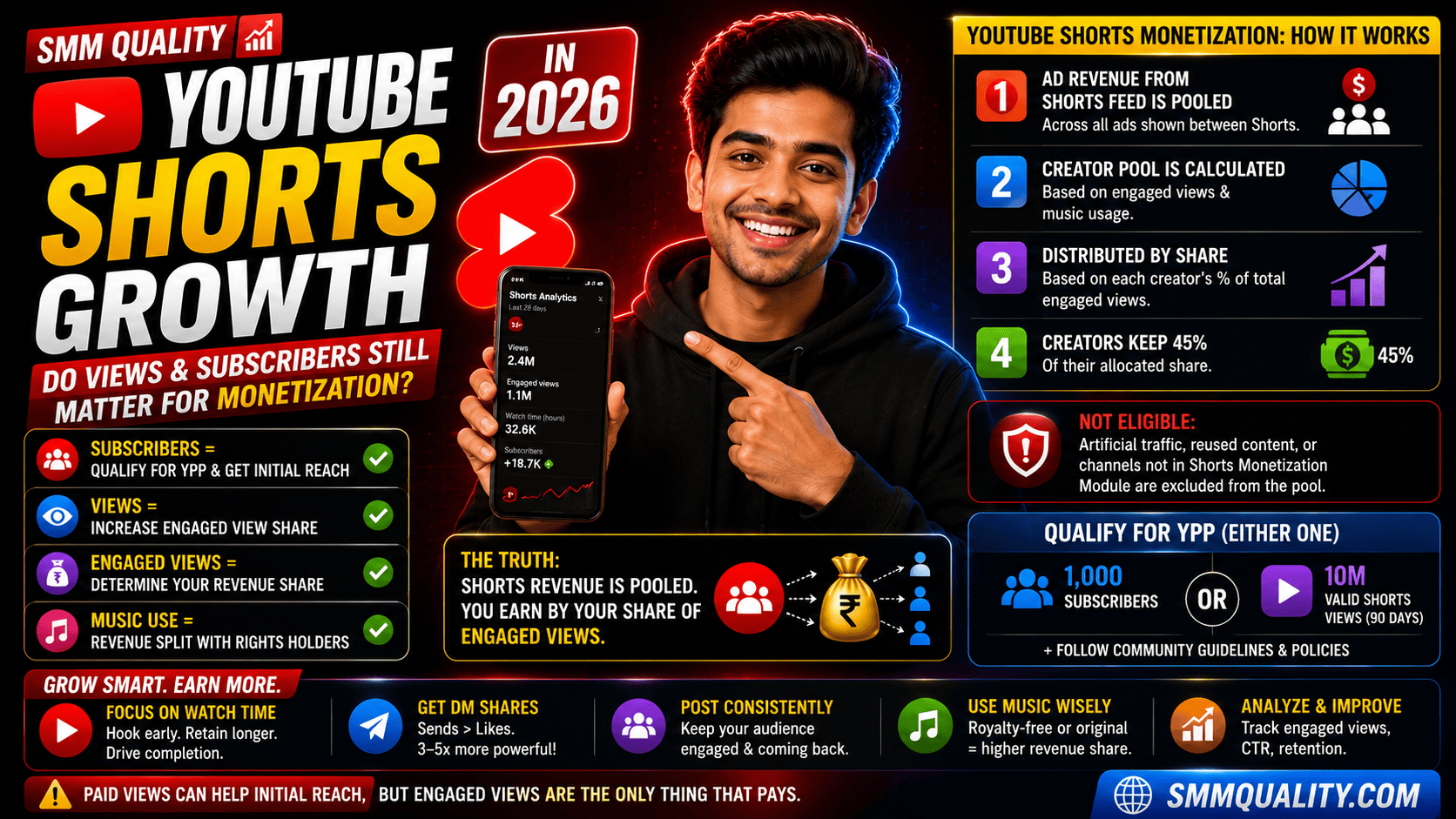
Quick Answer: Yes, but through a mechanism many creators misunderstand. YouTube's own Help Center documentation confirms Shorts revenue is calculated through a pooled model: ad revenue from the Shorts feed is combined monthly, then distributed to monetizing creators based on each creator's share of total eligible views - not a per-view rate on individual Shorts. Subscribers and long-form watch hours matter for a separate reason: they're one of two paths to qualifying for the YouTube Partner Program in the first place, alongside a views-based Shorts-specific threshold.
What YouTube Has Actually Confirmed About Shorts Monetization
This is one of the more reliably documented corners of the creator economy, since YouTube publishes the mechanics directly rather than leaving them to third-party inference. According to YouTube's own Shorts monetization policy documentation, the process works in four confirmed steps:
-
Ad revenue from the Shorts feed is pooled monthly - combined across all ads shown between Shorts, rather than tied to any individual video.
-
The Creator Pool is calculated from that pooled revenue, allocated based on engaged views and music usage across all monetizing creators' Shorts.
-
Revenue is distributed by share of total engaged views - if a creator's Shorts account for 5% of all eligible engaged views from monetizing creators in a given country that month, they receive 5% of that country's Creator Pool.
-
Monetizing creators keep 45% of their allocated share, regardless of whether music was used, per YouTube's published policy.
Views from artificial traffic, reused or unmodified content, or channels that haven't yet accepted the Shorts Monetization Module are explicitly excluded from the pool by policy - they don't count toward a creator's share and don't dilute anyone else's.
Qualification vs. Revenue Calculation: Two Different Things
A lot of confusion in this space comes from conflating qualifying for monetization with how much a Short earns once qualified. They're governed by different mechanics.
Qualification requires reaching the YouTube Partner Program threshold - 1,000 subscribers plus either 4,000 valid public watch hours on long-form content in the past 12 months, or a Shorts-specific views threshold in the last 90 days, per YouTube's current published requirements. Only one of these two paths is needed, not both.
Revenue calculation, once qualified, runs entirely on the pooled Creator Pool model above - completely separate from the subscriber count that got a creator into the program in the first place.
This means subscriber count and watch hours matter for getting in the door, and engaged view share matters for how much comes through it - two different gates, not one continuous scale.
Why Subscribers Still Matter Even Though Revenue Is View-Pooled
Given the pooled model, it's fair to ask why subscriber count would matter at all beyond initial qualification. Two real reasons:
First-hour distribution still runs through existing subscribers. A Short is shown to subscribers first, and their early watch behavior remains a meaningful input into whether YouTube's recommendation system tests it more broadly - independent of how Shorts revenue itself gets calculated afterward.
Engaged views, not raw views, are what count toward the pool. YouTube's documentation is specific that only engaged views from real users count - this is a distinction that matters directly for anyone considering a paid visibility service, since the pooled model has no mechanism to reward view count that doesn't reflect genuine engagement. A modest boost to a new Short's early view count can help it clear the same cold-start visibility problem long-form content faces, but it does nothing to inflate actual Creator Pool earnings, because ineligible or non-engaged views are explicitly excluded from the revenue calculation by policy.
What Actually Drives a Short's Distribution (Separate From Revenue)
| Factor | Role |
|---|---|
| Early watch-through rate | Strong input into whether YouTube tests a Short more broadly |
| Music usage | Reduces the Creator Pool allocation for that Short specifically, per YouTube's revenue-split policy - an economic factor, not a distribution one |
| Engaged view share | Directly determines revenue once in the Partner Program |
| Subscriber base | Drives first-hour reach; separate from the revenue pool mechanic |
A Point Worth Being Direct About
Because YouTube's own policy explicitly excludes non-engaged and ineligible views from the Creator Pool calculation, there's no revenue-side incentive to inflate Shorts view counts artificially - it doesn't move the actual number that matters. The one place a modest visibility service plausibly helps is the same cold-start problem long-form content face: giving a new Short's first hour enough activity to get a fair shot at YouTube's initial distribution test, not to affect the payout calculation, which runs on engaged views specifically and by design resists exactly that kind of inflation.
How to Check This Against Your Own Channel
YouTube Studio exposes the relevant data directly, so this is checkable rather than taken on faith:
-
Check "Shorts feed engaged views" versus total views for a recent Short in Studio's analytics. A large gap between the two is the flagged signal for content that isn't being counted toward the revenue pool, regardless of raw view count.
-
Review the Shorts Monetization Module acceptance date against your earliest monetized Shorts - views before acceptance don't retroactively qualify, per YouTube's own policy, which is a common source of confusion when creators check their first payout and it's lower than expected.
-
Compare RPM between a Short using licensed music and one using original audio or the royalty-free library, over a similar view count. The gap reflects the revenue split with music partners described in YouTube's own policy, not a ranking penalty.
This kind of direct check against Studio data is a more reliable basis for strategy than any general guide, including this one, since the actual numbers are already sitting in the dashboard.
Practical Strategy Given How the Mechanics Actually Work
-
Treat Shorts monetization as two separate goals - qualifying for YPP (subscriber/watch-hour threshold) and maximizing engaged view share afterward (content and consistency, not view count alone).
-
Skip trending licensed music if maximizing per-Short revenue matters, since YouTube's own policy confirms music usage reduces that Short's Creator Pool allocation specifically.
-
Don't expect a visibility boost to move the revenue needle. It can help a new Short clear its first-hour test; it cannot inflate engaged-view share, which is explicitly filtered against exactly that kind of pattern by policy.
-
Pair Shorts with long-form content deliberately rather than treating them as separate strategies - Shorts revenue is pooled and comparatively low per-view; long-form retains the traditional 55% creator revenue share on individually-placed ads, a materially different economic model worth understanding rather than assuming Shorts operate the same way.
Frequently Asked Questions
Q: Do YouTube Shorts require 4,000 watch hours to monetize?
A: No - Shorts have a separate views-based qualification path; a channel needs either the traditional watch-hours threshold or a Shorts-specific engaged-views threshold, not both, per YouTube's current published requirements.
Q: Does a paid visibility boost increase Shorts ad revenue directly?
A: No, based on YouTube's own documented mechanics. Revenue is calculated from engaged, eligible views specifically; non-engaged and ineligible views are explicitly excluded from the Creator Pool by policy.
Q: Why do subscribers matter if revenue is pooled by view share?
A: Subscribers drive a Short's first-hour distribution and are one of two paths to Partner Program qualification in the first place - a separate function from the revenue-pooling mechanic that applies afterward.
Q: Does using licensed music in a Short reduce earnings?
A: Yes - per YouTube's own Shorts monetization policy, revenue from a Short using licensed music is split between the Creator Pool and music rights holders before the creator's 45% share is calculated.
Q: Can a channel build real income from Shorts alone?
A: Technically yes, but the pooled, low-per-view economics mean most creators use Shorts primarily to grow subscriber base and drive traffic toward long-form content, where the traditional, higher per-video revenue share applies.
Sparkhouse manages content for SMMquality; that relationship is disclosed above. Claims about platform ranking signals are sourced to YouTube's own public statements where possible, with third-party or leaked-document claims clearly distinguished from confirmed platform policy.
By Ishita Ghai | SEO Specialist, Sparkhouse
Disclosure: Sparkhouse manages content and marketing for SMMquality. Website: smmquality.com