Searching "how to get more YouTube views" turns up two kinds of advice. One is a list of tricks. The other is a pitch to buy views.
We run a growth service, and we'll tell you why we don't recommend the second for most channels: YouTube's rules don't allow it, and the views don't last. What works is making videos people click, keep watching, and feel good about. This guide shows how.
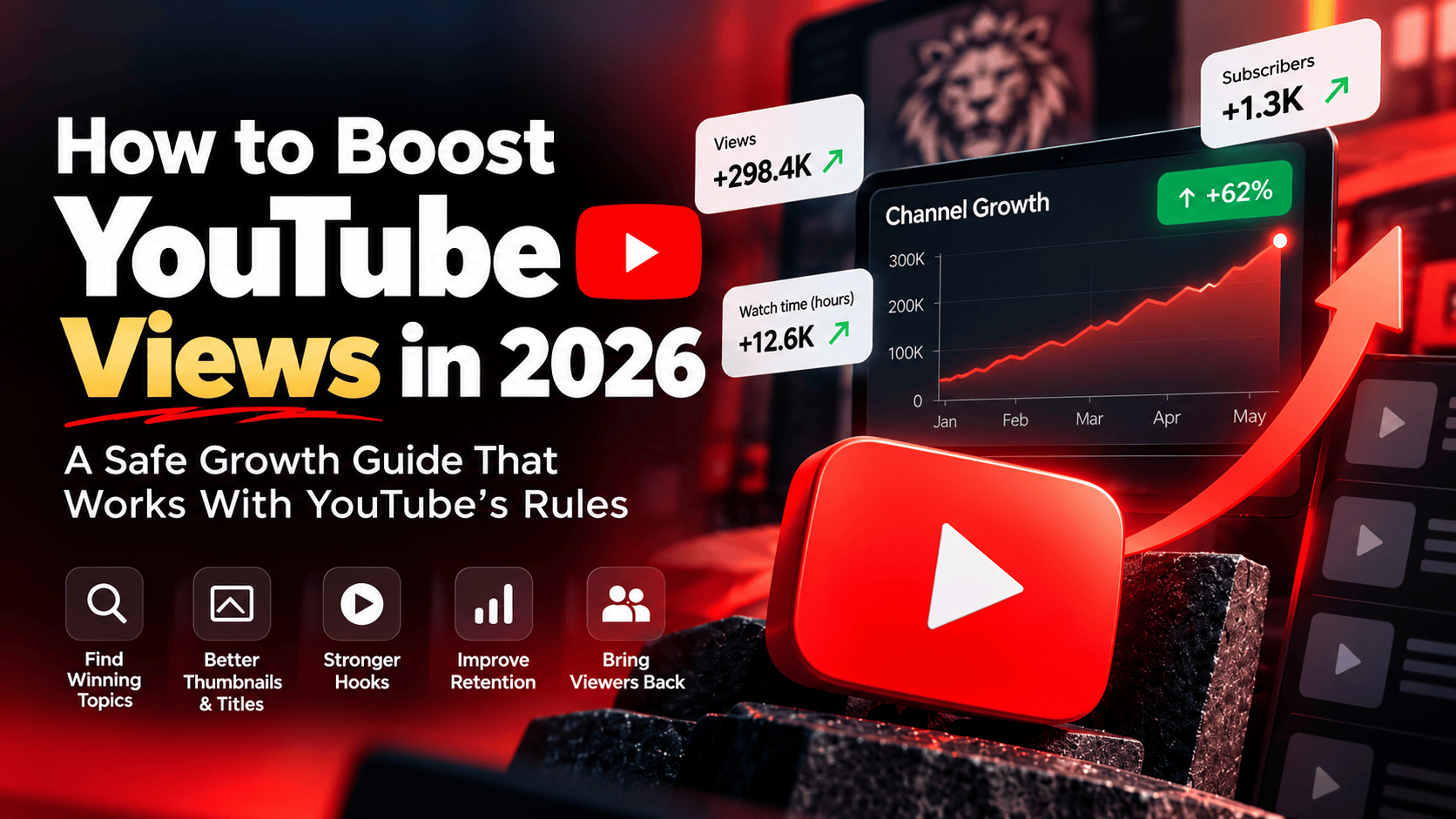
Short answer: To boost YouTube views, pick topics people already search for, package each video with an honest title and thumbnail, hook viewers in the first 30 seconds, fix the points where people drop off, and deliver on your promise so viewers come back. Check your Analytics weekly. Buying views isn't a safe shortcut, because YouTube prohibits artificial views.
How YouTube Decides What to Show
YouTube doesn't just rank by view count. It tries to show each viewer videos they'll want to watch and be satisfied by. Creators generally track three things:
| Signal | What it asks | Where to find it |
|---|---|---|
| Click-through rate (CTR) | Do people click when they see the thumbnail and title? | Analytics → Reach |
| Average view duration and retention | Do they keep watching? | Analytics → Engagement |
| Satisfaction and return visits | Were they happy, and do they come back? | Returning viewers, likes, shares |
CTR is best judged against your own channel's average, not someone else's number. A video that beats your usual CTR and holds viewers is a strong candidate to be shown more widely.
YouTube also recommends videos in several places: Home, Suggested, Search, and Shorts. Each rewards slightly different things, which is why the steps below cover more than one.
Step 1: Choose Topics People Already Want
Great production on a topic nobody searches for gets few views. Start with demand.
-
YouTube's search bar. Type your topic and see what it suggests.
-
Other creators' videos in your niche. Which ones have far more views than the channel's usual?
-
Comments on your own videos. Viewers tell you what to make next.
-
Question tools, such as AnswerThePublic, show what people ask.
Choose topics where you can say, in a sentence, what the viewer will get.
Step 2: Package Each Video Honestly
The title and thumbnail decide whether someone clicks. Your job is a promise that's attractive and true.
| Do | Avoid |
|---|---|
| One clear promise | Three promises in one thumbnail |
| A readable face or object, even when small | Tiny text nobody can read on a phone |
| A title that says the outcome | Misleading claims the video doesn't deliver |
| Testing two thumbnail ideas over time | Changing everything at once |
A misleading thumbnail may win the click but loses the viewer in ten seconds, and that hurts the video more than a lower CTR would. Match the promise to the video.
Step 3: Hook Viewers in the First 30 Seconds
Most viewers decide quickly whether to stay.
A simple opening structure:
- Say the payoff — what they'll get by the end.
- Show a piece of proof — a result, a clip, a number.
- Tell them what's coming — in one line.
- Start. No long intro, logo animation, or "before we begin."
Cut anything that doesn't earn its seconds.
Step 4: Fix Retention Using Your Own Graph
Your audience retention graph tells you exactly where people leave. Open it for each video.
| What the graph shows | What it usually means | What to do |
|---|---|---|
| Big drop in the first 30 seconds | Weak hook or the video doesn't match the thumbnail | Rework your openings and align the promise |
| Steady slope | Normal | Look for ways to add variety |
| Sudden cliff mid-video | A boring or confusing section | Tighten or cut that section next time |
| Spike (rewatch) | A moment people loved | Make more of that |
| Flat ending | Viewers stay to the end | Point them to a next video |
Pick one fix per video and apply it to your next upload.
Step 5: Make Viewers Want Another Video
YouTube pays attention to whether people feel their time was well spent and whether they come back.
-
Deliver exactly what you promised.
-
Point to a related video with an end screen or a line in the video.
-
Build playlists so one video leads to the next.
-
Ask for a subscription once, in a place where it makes sense.
-
Answer comments early. It builds a returning audience.
Step 6: Use Shorts as a Door
Since March 31, 2025, a Shorts view counts each time a Short starts or replays, with no minimum watch time. YouTube keeps a stricter number called engaged views, which shows how many viewers chose to keep watching.
So don't judge a Short by raw views alone. In Analytics, check engaged views and how many people stayed.
Use Shorts to:
-
Preview a longer video.
-
Answer one question from your comments.
-
Test hooks before you build a full video around them.
Add a pointer to the full video in the description or comments.
Step 7: Make Videos Easy to Find in Search
-
Put the main phrase early in the title, in natural language.
-
Write a clear first two lines of the description, since people see them first.
-
Add chapters for longer videos.
-
Upload captions or check the auto ones for errors.
-
Pick a specific topic instead of a vague one.
Step 8: Keep a Rhythm
Consistency lets viewers know what to expect. Choose a schedule you can keep for months. One strong video a week beats three rushed ones and then silence. Batch your filming when you can.
The Weekly Review
Spend 20 minutes in YouTube Analytics each week.
| Check | What it tells you |
|---|---|
| Impressions and CTR | Whether your packaging earns clicks |
| Average view duration | Whether the video holds attention |
| Retention graph | Exactly where people leave |
| Traffic sources | Where views come from: Search, Suggested, Home, Shorts |
| Returning viewers | Whether people want more of you |
| Engaged views (Shorts) | Whether Shorts viewers actually watched |
Then make more of what worked.
Your 30-Day Plan
| Week | Focus |
|---|---|
| Week 1 | Choose a niche sentence. Research ten topics people search for. Plan four videos |
| Week 2 | Film and publish video one with an honest package and a strong hook |
| Week 3 | Review retention for video one. Publish video two with one fix applied |
| Week 4 | Add two Shorts that point to your long videos. Compare CTR and retention to week 2 |
Mistakes That Hold Views Back
Misleading thumbnails. Clicks without watching hurt the video.
Long intros. Most viewers leave before the point.
Never opening the retention graph. It's free advice for each video.
Chasing trends outside your niche. The audience you attract won't stay.
Quitting after five videos. Most channels grow slowly at first.
Buying views. See the next section.
What About Buying YouTube Views?
We'll be direct, because this is where channels get hurt.
YouTube's fake engagement policy doesn't allow anything that artificially increases views, likes, comments, or other metrics. YouTube says channels and content that don't follow it may be terminated. It also says that if you hire someone to promote your channel, their decisions can affect your channel. And views it identifies as artificial aren't counted in your totals, so what you paid for can disappear.
Our view:
-
Monetized channel or one you plan to monetize: don't. The risk isn't worth it.
-
A channel you can't afford to lose: don't.
-
Anyone else: understand the risk first. Read Is Using an SMM Panel Safe?.
Views you pay for also can't create watch time from interested viewers, which is the thing that moves a video's reach.
Where SMMQuality Fits
SMMQuality is an India-based SMM panel for creators, small businesses, digital agencies, and resellers. YouTube is one of six platforms we cover, along with Instagram, Facebook, X (Twitter), TikTok, and Telegram, with services from ₹5. Our support is available around the clock.
For YouTube, our honest advice is this guide: build videos people want to watch first. If you ever consider a service, start with our safety article, and never with a channel that earns money.
Read our honest guide to panel safety →
FAQs
How do I get more views on YouTube?
Choose topics people search for, use an honest title and thumbnail, hook viewers in the first 30 seconds, fix drop-off points shown in your retention graph, and publish consistently.
What matters most for YouTube views?
Click-through rate compared with your own average, how long people watch, and whether viewers are satisfied and return.
What is a good YouTube click-through rate?
It varies by niche and channel. Compare each video with your own channel's average rather than a fixed number.
How do YouTube Shorts views work?
Since March 31, 2025, a Short's view counts when it starts or replays. Engaged views, in Analytics, show how many people kept watching.
Do Shorts help my long videos?
They can, if you use them to preview a video, answer a question, and point viewers to the full video.
Is buying YouTube views safe?
No. YouTube prohibits artificially increasing views, says violating channels may be terminated, and doesn't count artificial views in your totals.
How long does it take to grow on YouTube?
It varies a lot. Judge progress by retention, CTR, and returning viewers, not only by view count.